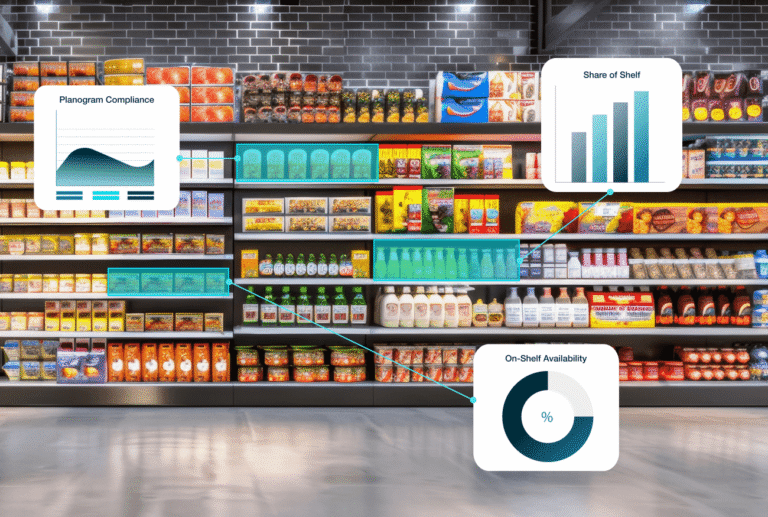


A retail planogram doesn’t fail in the boardroom. It fails in aisle seven, when a field rep skips a facing because the audit form doesn’t flag it, or when a misplaced product sits on the physical shelf undetected for two weeks before anyone notices the sales dip.
Most retail planogram strategies aren’t broken at the planning level. What breaks is the gap between what headquarters designed and what actually ends up in your retail stores—and that gap costs more than most tracking systems are built to reveal.
The signs are consistent across retail organizations: out-of-stocks hiding behind healthy-looking inventory data, inconsistent shelf placement across multiple store locations, field teams buried in manual reporting, no real-time visibility into shelf conditions, and planogram compliance metrics that can’t tell you whether your merchandising strategy is actually driving sales performance.
If any of those sound familiar, your planogram strategy may be working against you.
Key Takeaways
- Planogram compliance breaks down at the execution level, not the planning level—and the revenue impact compounds quietly across multiple locations
- Frequent out-of-stocks, inconsistent shelf layouts, and manual reporting are early warning signs that your strategy isn’t reaching the shelf
- Without real-time visibility into shelf conditions, teams are managing yesterday’s problems instead of preventing tomorrow’s
- Modern tools like image recognition AI and mobile task management close the gap between HQ strategy and in-store reality—at scale
What Is a Planogram in Retail?
A planogram is a schematic drawing that dictates exactly how products should be arranged on retail shelves—specifying shelf placement, product dimensions, facing counts, and the logic behind:
- Vertical product placement: Organizing products by brand or category from top to bottom
- Horizontal product placement: Arranging products across a shelf to guide customer flow and maximize visibility
- Block placement: Grouping products together to strengthen brand identity and drive impulse purchases
It’s the blueprint your merchandising strategy runs on. For CPG brands and retailers managing product placement across multiple store locations, an effective planogram is the difference between optimizing shelf space and leaving revenue on the table. A well-designed planogram accounts for customer flow, consumer behavior, and visual appeal—turning every square foot of retail space into a deliberate selling tool.
But a planogram is only as good as its execution. And that’s where most retail businesses run into trouble.
Why Does Retail Planogram Execution Break Down?
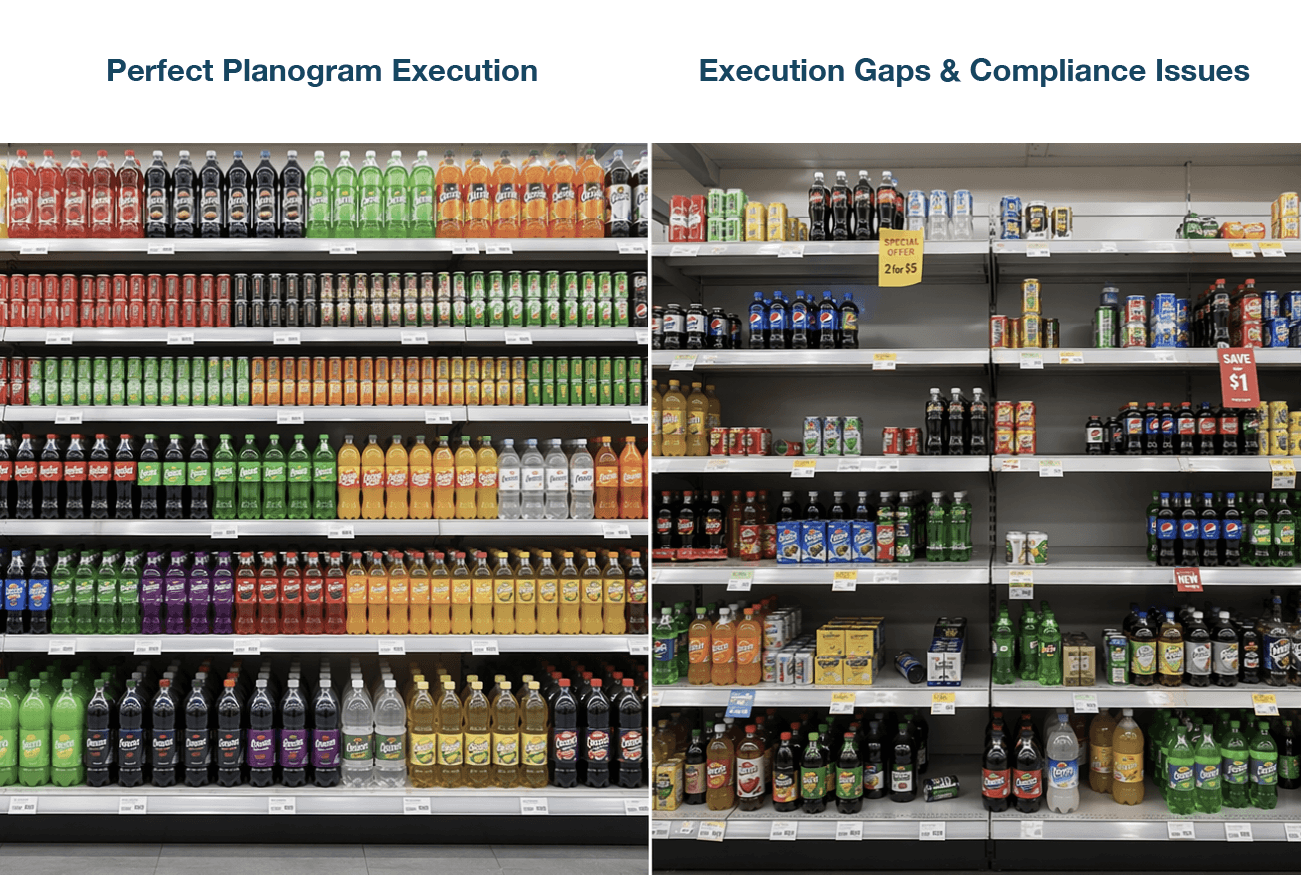
A well-designed planogram accounts for consumer behavior, product dimensions, shelf space, and strategic product placement. But even the most precise schematic drawing means nothing if it isn’t executed consistently across every retail store in your network.
The breakdown rarely comes from a lack of effort. It comes from a structural mismatch between how planograms are built and how they’re enforced in the field. Headquarters designs against ideal conditions—optimizing shelf space, maximizing visibility, and aligning product placement to customer flow and consumer preferences. Field teams execute against reality.
The most common culprits are consistent across retail organizations:
- Manual audits and spreadsheet reporting that create the illusion of oversight without delivering real-time visibility into shelf conditions
- Delayed reporting cycles that surface compliance issues days or weeks after the fact—long after the opportunity to act has passed
- Inconsistent workflows across store locations that cause execution quality to vary widely from rep to rep and store to store
- Inventory data that doesn’t reflect shelf reality, leaving teams making decisions based on what the system believes rather than what’s actually on the physical shelf
The result is a feedback loop that’s too slow to protect sales performance. By the time issues surface, the promotional window may already be closed, and the lost sales opportunities already locked in. What’s needed isn’t a better planogram design but faster, more accurate visibility between the physical shelf and the people responsible for it.
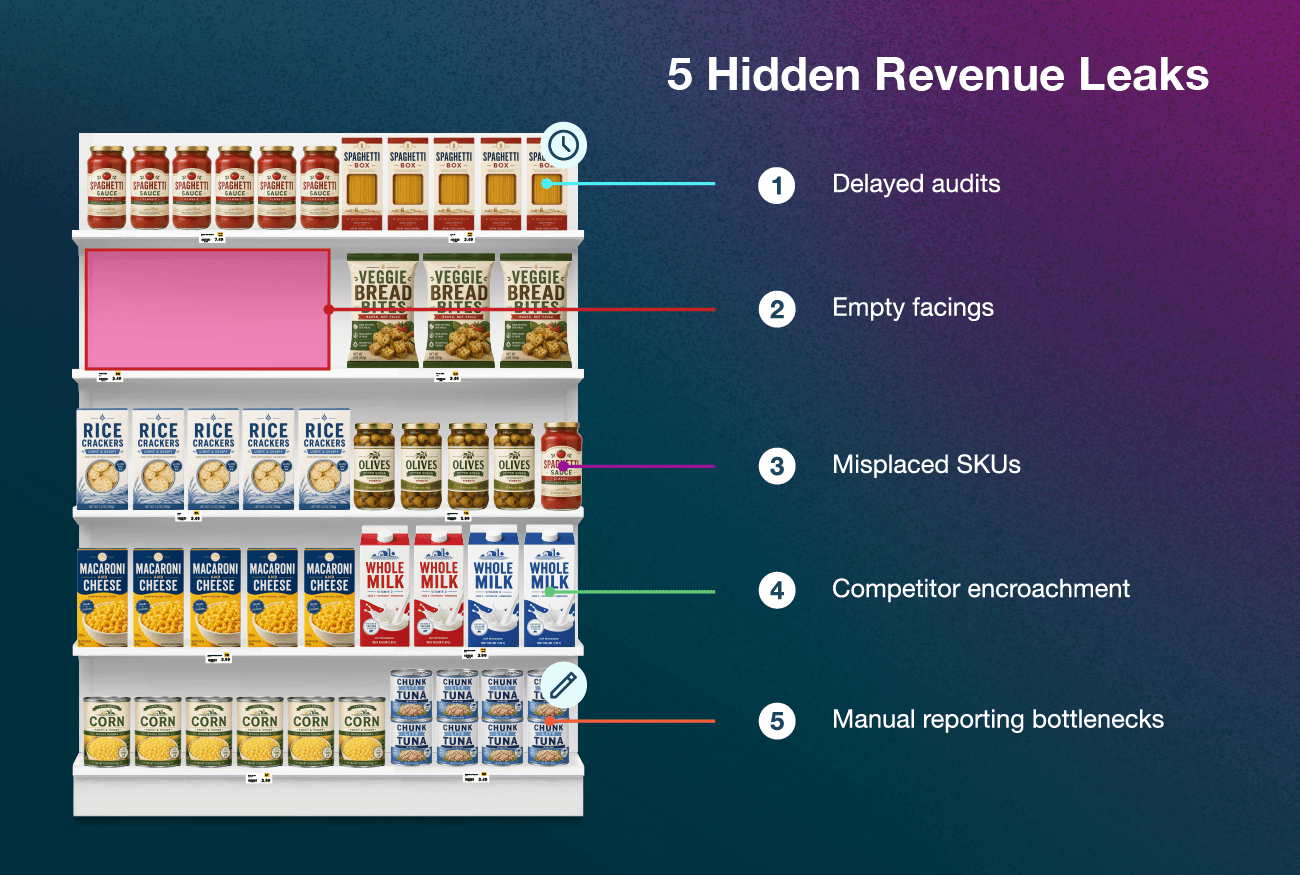
5 Ways Your Retail Planogram Strategy Is Losing You Sales
1. Frequent Out-of-Stocks, Despite “Full” Inventory
Your inventory management system says the product is there. The physical shelf tells a different story.
This is one of the most common and costly planogram compliance failures in retail—and it’s especially damaging because the data actively obscures the problem. When inventory levels look healthy in the system, there’s no automated trigger to investigate, no urgency for field teams to look harder, and no signal that anything is wrong until sales performance starts to slip.
The root causes are well-documented:
- Products sitting in backroom storage that never make it to the floor
- Shrinkage and damage that goes unlogged
- Misplaced SKUs quietly occupying facings that belong to high-velocity items
At scale, these gaps compound across hundreds of store locations—and the cost is staggering. In recent years, out-of-stocks alone cost retailers $1.2 trillion globally, the result of shoppers who came ready to buy but left empty-handed.
2. Inconsistent Shelf Execution Across Store Locations
A retail planogram only drives retail success if every store is running the same play. When shelf layout and product placement vary from location to location, the impact reaches further than most teams realize.
Inconsistent execution across multiple stores typically surfaces in a few familiar ways:
- Brand identity erodes when visual merchandising standards aren’t applied consistently, undermining the visual appeal your planogram design was built to deliver
- Customer experience suffers as shoppers encounter a different store layout depending on which location they visit, eroding the familiarity and customer satisfaction that drives repeat purchases
- Competitive positioning weakens as inconsistent shelf space allocation hands competitors room to expand their facings and gain market share placement
The challenge isn’t that store managers don’t care about compliance, but that manual enforcement doesn’t scale. When your audit process relies on rep-reported data and periodic store visits across different store locations, inconsistencies have days or weeks to compound before anyone catches them. Customer behavior is shaped by what’s on the shelf in front of them, not what your planogram says should be there.
3. Field Teams Spend More Time Reporting Than Selling
Every minute a field rep spends on manual data entry, spreadsheet updates, and photo uploads is a minute they’re not spending on shelf negotiations, store manager relationships, or incremental display opportunities.
The administrative burden of traditional planogram enforcement is significant:
- Manual counting and form completion slow down every store visit and reduce the number of retail stores a rep can cover in a day
- Duplicate data entry across disconnected systems creates errors, delays, and an incomplete picture of shelf conditions across multiple locations
- Delayed photo uploads that give headquarters fragmented, out-of-date sales data rather than the real-time sales data needed to act
When store staff are spending more time on reporting than execution, the planogram suffers—and so does sales volume. The most effective retail strategies free field teams to focus on boosting sales and customer engagement, not administrative overhead.
4. You Lack Real-Time Visibility Into Shelf Conditions
Delayed reporting is a revenue problem. When the data your leadership team relies on is days old, every decision it drives is reactive by definition, and you are responding to problems that have already cost you sales rather than preventing them.
Without real-time sales data and shelf visibility, retail organizations consistently face the same pattern:
- Compliance failures go undetected until well after the promotional window closes, turning your trade spend into a subsidy for competitors
- Seasonal products sit misplaced across multiple shelves because no one is flagged to fix them in time to capture peak consumer demand
- Leadership makes trade decisions based on inventory data that no longer reflects physical shelf reality
- Competitors gain facings while your team is still waiting on last week’s audit results
The gap between what’s happening in store and what your system believes is happening is where retail sales are quietly lost every single day.
5. You Can’t Accurately Measure Planogram Compliance or ROI
If you can’t measure it, you can’t manage it. For most retail businesses, planogram compliance is tracked too broadly, too slowly, and too manually to drive meaningful action. Fewer than 1 in 4 retailers are achieving 80%+ accuracy in key shelf metrics—and 1 in 2 are reporting lost sales as a direct result.
Planogram compliance refers to how consistently your shelf layout matches the intended planogram design across every store in your network. But most traditional tracking methods fall short:
- Aggregate sales data that masks SKU-level performance issues, making it impossible to connect shelf placement decisions to actual sales volume
- Rep-submitted audit forms that reflect consumer preferences and product placement standards on paper, but can’t verify what’s actually on the physical shelf
- No consistent baseline across different store locations, making it impossible to identify where execution is breaking down—or which stores are costing you the most in lost sales opportunities
Without accurate, SKU-level compliance data, optimizing retail planograms becomes guesswork. You’re left managing outcomes rather than driving them, and the gap between your merchandising strategy and your retail results keeps widening.
How to Fix Planogram Execution Gaps at Scale
A more effective planogram strategy doesn’t start with a better schematic drawing. It starts with closing the gap between what headquarters plans and what field teams actually execute—across every retail store, on every visit, in real time.
Modern retail planogram software and mobile execution tools make that possible in ways that manual processes never could. Here’s what a more effective approach looks like in practice:
Replace Manual Audits with AI-Powered Image Recognition
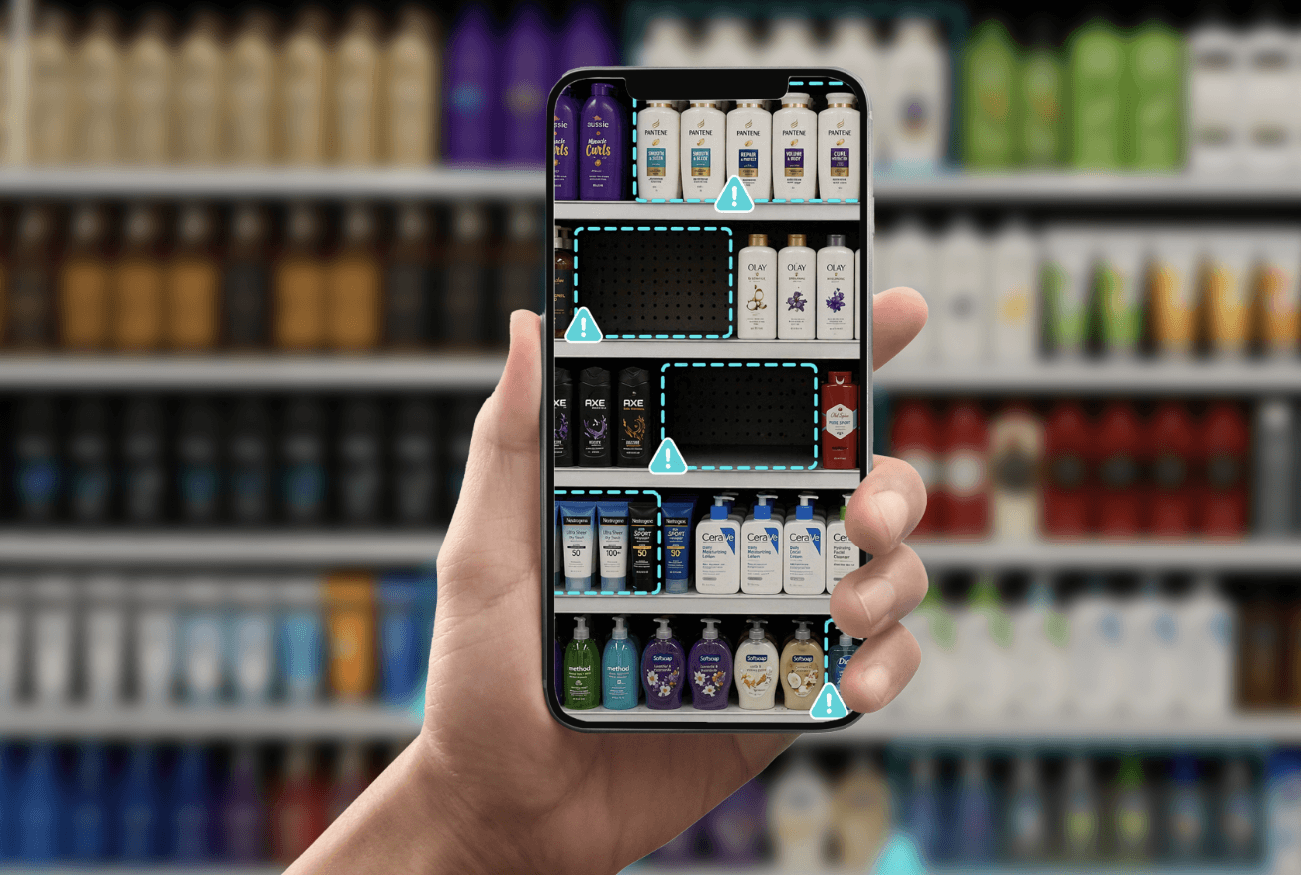 Instead of relying on rep-reported data and subjective checklists, image recognition technology turns a single shelf photo into instant, SKU-level compliance data. GoSpotCheck by FORM takes this further with augmented reality, allowing reps to hold up their phone as they walk the aisle and surface compliance gaps in real time. The result:
- Faster store visits with no manual counting or form completion
- Instant identification of misplaced SKUs and planogram deviations
- Real-time sales data and shelf compliance metrics captured on every visit
- A significant reduction in lost sales opportunities across multiple locations
Standardize Execution with Mobile Task Management
Optimizing shelf space across hundreds of store locations requires more than a well-designed planogram—it requires a workflow that guides every rep through the same process, every time. Mobile task management gives store staff a structured, guided experience that standardizes execution regardless of location, experience level, or connectivity:
- Guided task workflows that ensure consistent shelf layout and product placement across every store
- Offline-first functionality that keeps teams productive in basements, coolers, and low-connectivity retail environments
- Automatic data sync once connectivity is restored—no gaps, no guesswork, no missed locations
Turn Shelf Data Into Actionable Leadership Insights
Real-time sales data and shelf compliance metrics are only valuable if they reach the right people fast enough to act on. Modern retail merchandising platforms convert raw field data into executive dashboards that track:
- Share of shelf and void detection across multiple stores
- Pricing compliance and audit completion rates by location
- SKU-level sales performance tied directly to shelf placement decisions
- Early identification of underperforming promotions before the window closes
For a planogram specialist or merchandising director managing execution across different store locations, this shift from lagging to leading indicators is where the real competitive advantage lives. Instead of reviewing what happened last week, your team is responding to what’s happening right now, and maximizing sales opportunities while they’re still open.
Stop Managing Yesterday’s Shelf
A retail planogram is only as strong as its execution. The strategy, the planogram design, and the carefully optimized shelf space won’t drive retail success if it isn’t landing consistently on the physical shelf, across every store, on every visit.
The signs of a failing planogram rarely announce themselves loudly. They compound quietly—in inventory data that doesn’t reflect shelf reality, in compliance gaps that surface too late, in field teams spending more time reporting than selling. By the time they show up in your sales data, the revenue is already gone.
The good news? The gap between HQ strategy and in-store execution is a solvable problem. Explore FORM’s field sales management solution and see how real-time shelf data can improve planogram execution and drive your sales.
Frequently Asked Questions
How often should retail planograms be updated?
It depends on category velocity and promotional cycles. Fast-moving CPG categories may require monthly or quarterly planogram updates, while slower categories can be reviewed less frequently. The more important question is whether updates are actually being executed correctly in store—a perfectly timed planogram reset means nothing if the shelf doesn’t reflect it.
What is the difference between a planogram and a schematic drawing?
The terms are often used interchangeably, but a schematic drawing is the visual blueprint—specifying product dimensions, facing counts, and shelf placement. A planogram is the broader strategy it represents, encompassing product placement logic, customer flow, consumer behavior data, and merchandising objectives. In practice, the schematic is how you read a planogram and communicate it to store staff.
How do you measure planogram compliance across multiple store locations?
Most traditional methods rely on rep-submitted audit forms and periodic store visits—both of which are too slow and too subjective to give an accurate picture at scale. Modern retail planogram software uses image recognition AI to score compliance at the SKU level on every visit, giving merchandising directors and operations leaders an accurate, real-time view of shelf conditions across their entire store network.
Is poor planogram execution a people problem or a process problem?
Mostly process. Individual store managers and field reps are rarely the root cause—the bigger issue is that traditional planogram enforcement was never built for the scale and complexity of modern retail environments. When teams are equipped with mobile task management, guided workflows, and real-time sales data, execution consistency improves dramatically without adding headcount or hours to the field rep’s day.