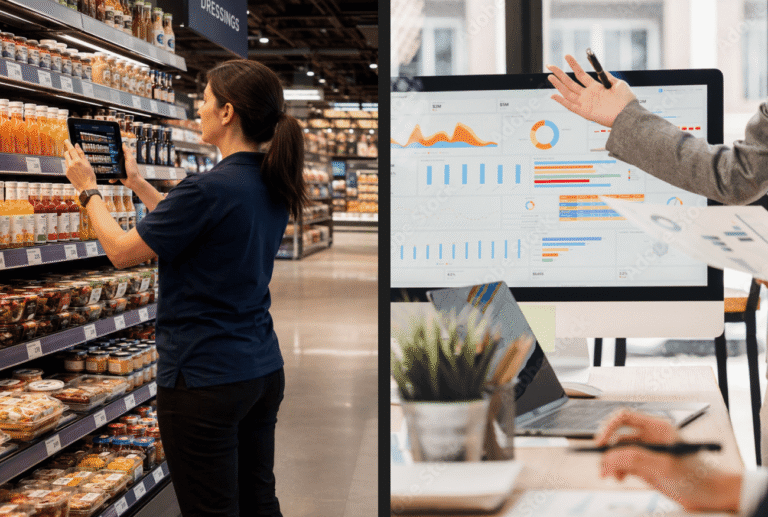
Q: How can stores tackle retail labor shortages and simplify operations?
A: Labor challenges aren’t new, but the urgency to address them has reached a tipping point. We often talk about a digital maturity model that retailers can follow to improve labor efficiency and workforce flexibility in their stores.
The model has three steps, each building on the one before:
| Step | What it involves | What it delivers |
|---|
| 1. Simplify and standardize in-store operations | One system for tasks across departments, regions and banners | Easier onboarding, cross-training and more time for store leaders |
| 2. Accelerate data capture and shelf intelligence | Image recognition checks out-of-stocks, pricing and planogram compliance | A complete picture of store execution in less time |
| 3. Augment store teams with third-party labor | Outside teams use the same task management and image recognition tools | Consistent standards, with store staff free for higher-value work |
It starts with Step One: Simplifying and standardizing in-store operations. Too often, we see different departments—produce, bakery, electronics, apparel—each running their own playbooks. While specialization is important, this fragmentation makes it harder for store teams to flex between departments when needed. A team member trained in one department can’t easily contribute in another, and managers spend more time guiding rather than leading.
By implementing one unified operational system across departments, regions, and banners, retailers can simplify task management and ensure consistency in how work gets done. This makes onboarding easier, allows employees to cross-train more effectively, and saves store leaders valuable time.
Step Two involves accelerating data capture and shelf intelligence. Technologies like image recognition enable store teams to quickly assess shelf conditions—out-of-stocks, pricing accuracy, planogram compliance—without manual effort. This data gives leaders a more complete picture of store execution in far less time.
And finally, Step Three is augmenting store teams with third-party labor, especially when labor budgets are tight. The key is equipping these third-party teams with the same task management and image recognition tools as full-time staff. This creates a seamless experience and ensures that retailers maintain operational visibility and quality standards, regardless of who’s doing the work. Store teams are then free to focus on higher-value tasks that require deep product knowledge or customer service expertise.
Q: How is AI helping brick-and-mortar stores keep up with e-commerce?
A: One of the greatest advantages e-commerce teams have is agility. They can pivot quickly—changing prices, promotions, or featured products in near real time—because digital catalogs and merchandising are so dynamic. Additionally, e-commerce generates structured data that’s highly accessible and actionable, giving teams the ability to optimize strategies on the fly.
Brick-and-mortar retail has traditionally lagged in this area, but that’s changing. Retailers are now using AI-powered image recognition technology to capture unstructured data—photos of shelves, displays, and store conditions—and instantly convert it into structured insights, such as shelf positioning, out-of-stocks, and compliance metrics.
This allows store operations, merchandising, and buying teams to make informed decisions faster than ever before. For example, retailers can now analyze shelf conditions leading up to key sales periods or holidays and quickly adjust store priorities or promotional strategies, much like they do in e-commerce.
Augmented reality is a way to visualize this transformation. Imagine a store associate viewing a shelf through their device’s camera and seeing real-time data overlays that highlight gaps, pricing issues, or planogram discrepancies. It’s a powerful example of how technology bridges the gap between unstructured and structured data, unlocking new levels of agility in physical stores.
Q: How is in-store data shaping in-store retail media and brand partnerships?
A: Retail media is transforming how retailers and suppliers work together. Historically, the focus has been on digital touchpoints, like e-commerce platforms and in-store digital signage, where brands pay for prioritized placement and advertising.
Now, forward-thinking retailers are expanding these partnerships by offering brands access to in-store data that complements their retail media strategies. Using image recognition and task management tools, retailers can capture and analyze shelf conditions, on-shelf availability, category dynamics, and planogram compliance—at scale and with minimal effort.
By sharing these insights with brand partners, retailers can provide a level of visibility into stores that was previously unattainable—without requiring brands to deploy additional labor. This helps brands optimize their assortments, improve stock levels, and fine-tune their category strategies, resulting in better outcomes for both the retailer and the supplier.
Retailers who embrace this model can position themselves as true strategic partners to brands—not just by selling shelf space or ad inventory, but by delivering valuable data and insights that improve execution and drive mutual growth.
Once again, AR plays a role here. Brands can visualize the data collected from stores overlaid onto images or store layouts, helping them quickly interpret complex insights and take action in their own strategies.
Q: How can retailers get started with digital transformation in their stores?
A: Start by simplifying store operations and building a unified system for task management and data capture across all departments. From there, layer in the other two steps of the maturity model.
As retailers adopt these technologies, they create a strong foundation for greater operational agility, enhanced supplier collaboration, and new revenue streams through retail media partnerships.
The future of brick-and-mortar retail starts with execution
The future of physical retail stores won’t be decided by store counts alone. It will come down to how well stores execute, every day and in every aisle. Shoppers still choose stores to see products in person and take them home right away, and younger shoppers in particular expect the shelf to deliver on that.
“The future of retail is data-driven, and those who invest in structured, actionable insights today will be best positioned to thrive tomorrow.”
Ali Moosani, CEO of FORM
For retail leaders, the next step is practical. Look at where your store teams lose the most time today, whether that’s switching between department playbooks, checking shelves by hand or chasing updates from outside labor partners. That’s usually where the payoff comes first, and where brick-and-mortar retail trends like AI-powered shelf intelligence and in-store retail media start turning into measurable results.