

Getting beer, wine, and spirits products into retail locations is a significant operational achievement. But for Bev-Alc suppliers and distributors, it’s only half the job. What happens after delivery is where sales are won or lost, and this means knowing whether products are placed correctly, promotions are activated, and merchandising standards are upheld.
Retail execution is the discipline that bridges liquor distribution strategy and in-store reality. And retail execution data is what tells you whether that bridge is actually holding. Without it, brands and distributors are making growth decisions based on assumptions rather than what’s genuinely happening at shelf level across their retail network.
Key Takeaways
- Retail execution determines whether liquor distribution actually translates into sales—getting products into stores is only part of the job
- Retail execution data reveals what’s really happening at the shelf level, showing whether planogram compliance, promotions, and merchandising standards are being followed consistently across retail locations
- Distribution without execution visibility creates blind spots—brands and distributors may believe field activity is occurring as planned, while store-level execution can vary widely across their network
- Improving execution consistency directly improves Bev-Alc growth because stronger compliance with in-store standards leads to better product placement, stronger brand presence, and more reliable sales outcomes
What Is Retail Execution Data?
Retail execution data is the structured information collected from retail store operations that tells suppliers and distributors whether their in-store strategy is being carried out as intended. In the context of liquor distribution, it answers a deceptively simple question: Is what was planned actually happening on the shelf?
To answer that question, brands and distributors typically track several key categories of execution data that provide visibility into in-store performance and compliance:
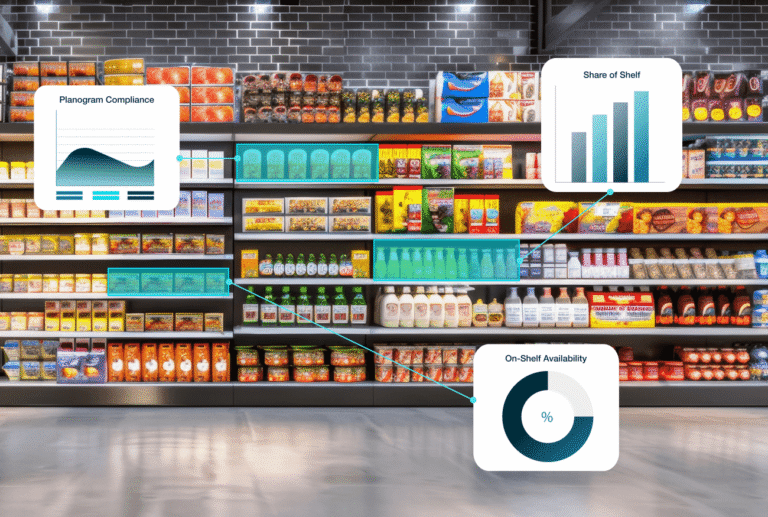
- Planogram compliance: Confirmation that wine, spirits, and beer products are positioned correctly on the shelf, with the right facings and in the agreed locations
- Promotional execution: Verification that promotions are activated correctly and on time, ensuring trade investment reaches customers rather than remaining unexecuted in a back room
- Merchandising compliance: Assessment of whether displays, signage, and product placement align with brand standards across every location
- Store audit results: Structured data captured by field reps during store visits, providing a verifiable record of execution quality at the location level
Together, these data sources give distributors and brands something that distribution metrics alone cannot: visibility into execution quality. A product can be listed, delivered, and recorded as available in a system while simultaneously being misplaced, out of compliance, or missing from a promotional display entirely. Retail execution data is what turns assumptions about store performance into real-time insights that teams can actually act on.
Why Liquor Distribution Alone Doesn’t Guarantee Performance

For many Bev-Alc brands and wholesalers, liquor distribution is treated as the primary measure of market reach. If a product is listed and delivered, the assumption is that it’s working. But distribution coverage and execution quality are two very different things—and confusing one for the other is one of the most common and costly blind spots in the industry.
A product can be physically present in a store and still be effectively invisible. If it’s shelved in the wrong location, missing from a promotional display, or facing the wrong direction in a cooler, the customer experience suffers, and the sale is lost, regardless of how strong the supply chain behind it is. This is the distribution-versus-execution gap, and it quietly undermines brand performance across retail networks every day.
Common Execution Gaps in Liquor Distribution
Execution gaps in liquor distribution tend to follow consistent patterns. Understanding them is the first step toward closing them:
- Missing or incomplete in-store execution: Products are delivered, but displays aren’t built, promotions aren’t activated, or shelf resets are only partially completed
- Inconsistent merchandising standards: Brand standards for placement, signage, and product placement vary widely from store to store, eroding brand presence across the network
- Lack of real-time visibility: Without retail execution software or structured reporting, teams have no reliable way to know whether execution is holding between field reps’ visits
- Weak feedback loops from field teams: Data captured during store visits is often informal, inconsistent, or never reaches the business stakeholders who need it most
These gaps don’t reflect a failure of distribution, but a failure of visibility. Without retail execution software, there’s simply no reliable mechanism to know what’s holding and what isn’t between visits.
The Role of Retail Execution in Bev-Alc Growth
Retail execution is a direct driver of store sales and brand performance. For Bev-Alc suppliers and distributors, execution quality at the shelf level determines whether trade investment actually reaches the customer, and whether promotions deliver the return they were designed to.
The connection between execution and growth is straightforward. Brands that execute consistently across their retail network see stronger results across every metric that matters:
- Brand presence that holds across locations rather than drifting between store visits
- Product placement that reflects the agreed planogram execution rather than whatever space is available
- Promotional activation that reaches the customer at the right moment, in the right store
- Competitive intelligence that surfaces when field reps report on what competitors are doing at the shelf level
That consistency becomes harder to maintain as retail networks scale. Category management decisions made at the business level require structured oversight to hold at the store level, and that oversight depends on having accurate, timely retail execution data flowing back from the field. Without it, even the strongest liquor distribution strategy will produce uneven results across the network.
How Retail Execution Data Solves These Problems

The value of retail execution data isn’t just in knowing that a problem exists, but in knowing where it exists, how severe it is, and which field reps or locations need attention first. That specificity is what separates reactive store management from a genuine retail execution solution.
When brands and distributors have access to structured execution data, four things become possible that aren’t achievable through manual reporting alone:
- Early identification of execution failures: Rather than discovering a missed promotion or planogram compliance issue weeks after the fact, teams can catch and correct problems during or immediately after a store visit
- Improved accountability across field teams: When field reps document their work through structured digital workflows, performance becomes measurable and consistent across the entire network
- Optimised store-level performance: Retail execution software surfaces which locations are underperforming and why, giving distributors and brands the real-time visibility they need to prioritise resources and support effectively
- Better merchandising decisions: Shelf analytics and audit results feed directly into category management and product placement strategy, closing the loop between what’s planned and what’s actually happening in store
Used well, retail execution data shifts the entire operating model from one where execution problems are discovered late and addressed reactively to one where operational efficiency is built into the field process itself. That shift is where the real value of a retail execution strategy becomes measurable.
From Data to Action in Liquor Distribution
Collecting retail execution data is only valuable if it drives the right action at the right time. For Bev-Alc teams, the goal is better execution outcomes across every store in the network. That requires a clear workflow connecting what field reps capture on the ground to the decisions teams make at the business level.
In practice, that workflow looks like this:
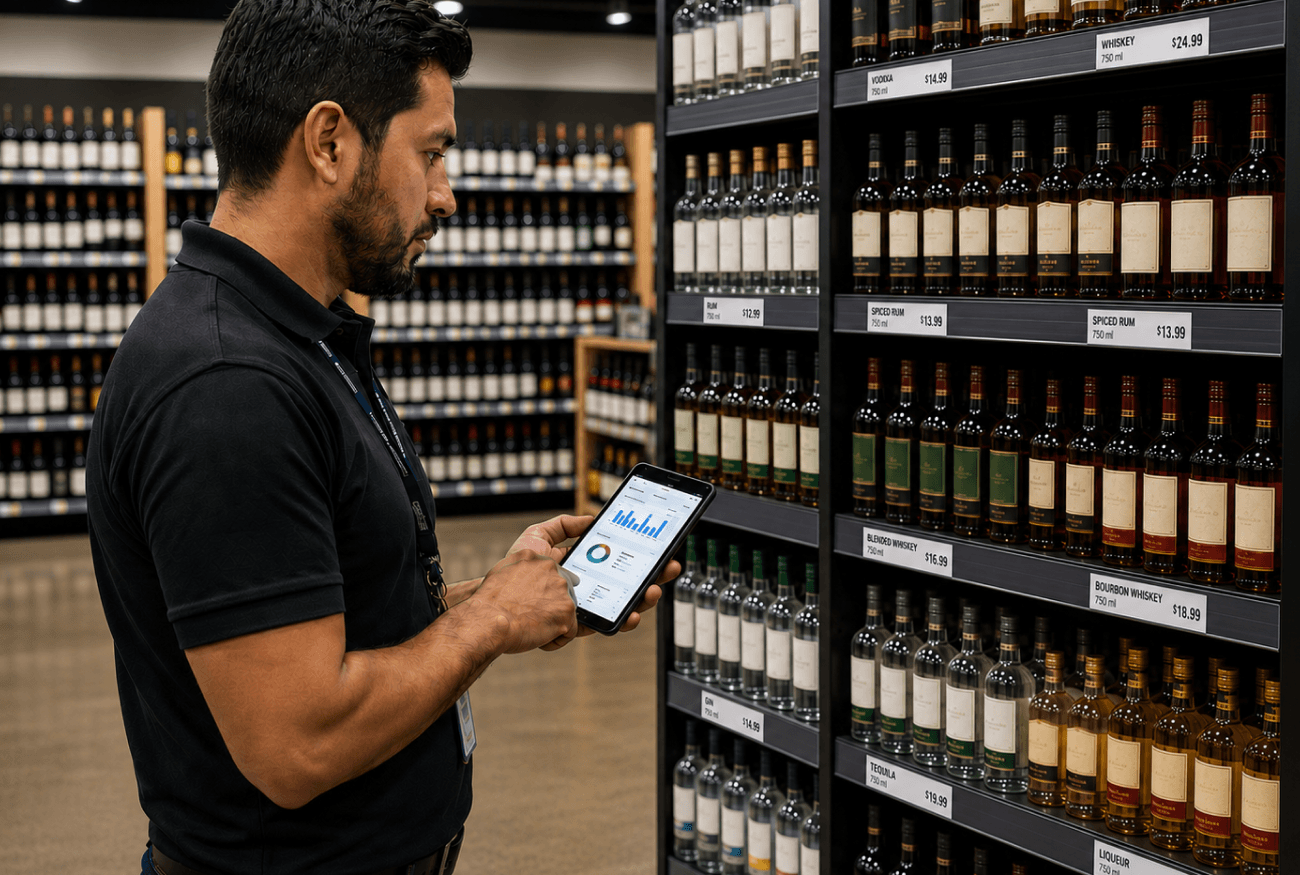
- Field execution tracking: Field reps complete structured store visit workflows using mobile retail execution software, capturing planogram compliance, display conditions, pricing, and promotional activation in real time
- Retail audits and reporting loops: Audit results flow automatically to regional managers and business stakeholders, replacing informal feedback with consistent, structured execution data that supports accountability across the network
- Prioritising underperforming stores: Real-time insights and shelf analytics allow distributors and brands to identify which locations need immediate attention, rather than spreading support evenly across national accounts regardless of performance
- Continuous execution improvement: Over time, execution data reveals patterns across locations, suppliers, and field reps, enabling brands and distributors to refine their retail execution strategy and raise the baseline standard of compliance across the network
When these workflows are connected and consistently followed, retail execution data stops being a reporting exercise and starts functioning as an operational system—one that gives every level of the business, from field reps to leadership, a shared and accurate picture of what’s happening in store.
The Distributors Winning in Bev-Alc Have This in Common
It isn’t always the brands with the widest liquor distribution footprint that outperform in competitive retail markets. More often, it’s the ones with the clearest picture of what’s happening at shelf level—and the workflows to act on it faster than everyone else.
Platforms like GoSpotCheck by FORM are built specifically to power this kind of connected field execution, giving BevAl brands and distributors the real-time visibility they need to turn liquor distribution strategy into measurable, store-level performance.
Book a demo today and experience how FORM helps Beverage suppliers and distributors improve retail execution visibility and turn liquor distribution strategy into measurable performance outcomes.
Frequently Asked Questions
How is retail execution data collected in liquor distribution?
Retail execution data is typically collected through structured field audits, mobile retail execution software, photo verification, and store-level check-ins completed by field reps during store visits. Rather than relying on informal feedback or manual spreadsheets, modern retail execution solutions capture whether planogram compliance, promotions, and merchandising standards are correctly implemented—turning in-store conditions into consistent, trackable performance data that distributors and brands can act on in real time.
Why do retail execution issues impact sales even when distribution is strong?
Distribution gets a product into a store, but retail execution determines whether it actually sells. If planogram execution isn’t followed, displays are missing, or promotions aren’t activated correctly, customers may not notice or engage with the product at all, regardless of how widely it’s distributed. Strong liquor distribution coverage without execution visibility creates a false sense of performance that only becomes apparent when sales data eventually reflects the gap.
What is the difference between retail execution and retail execution data?
Retail execution refers to the in-store activities that bring a brand’s strategy to life—stocking shelves, building displays, activating promotions, and maintaining planogram compliance. Retail execution data is the structured information captured from those activities, providing real-time visibility into whether execution is happening correctly and consistently across the network. One is the action; the other is the evidence that the action was carried out as intended.
How does retail execution data improve relationships with retailers?
When distributors and brands can demonstrate consistent planogram compliance, reliable promotional activation, and strong merchandising standards through verified execution data, it builds trust with retail partners. Retailers are more likely to award additional space, support promotions, and deepen relationships with suppliers who can prove their field teams are delivering, rather than simply claiming they are.
What should BevAl brands look for in a retail execution solution?
The most effective retail execution solutions for BevAl brands and distributors combine mobile-first field workflows, real-time data capture, photo verification, and analytics that surface actionable insights across the network. Shelf analytics, audit scoring, and automated reporting loops are particularly valuable in liquor distribution contexts, where execution standards need to be held consistently across large numbers of retail locations and field reps.