

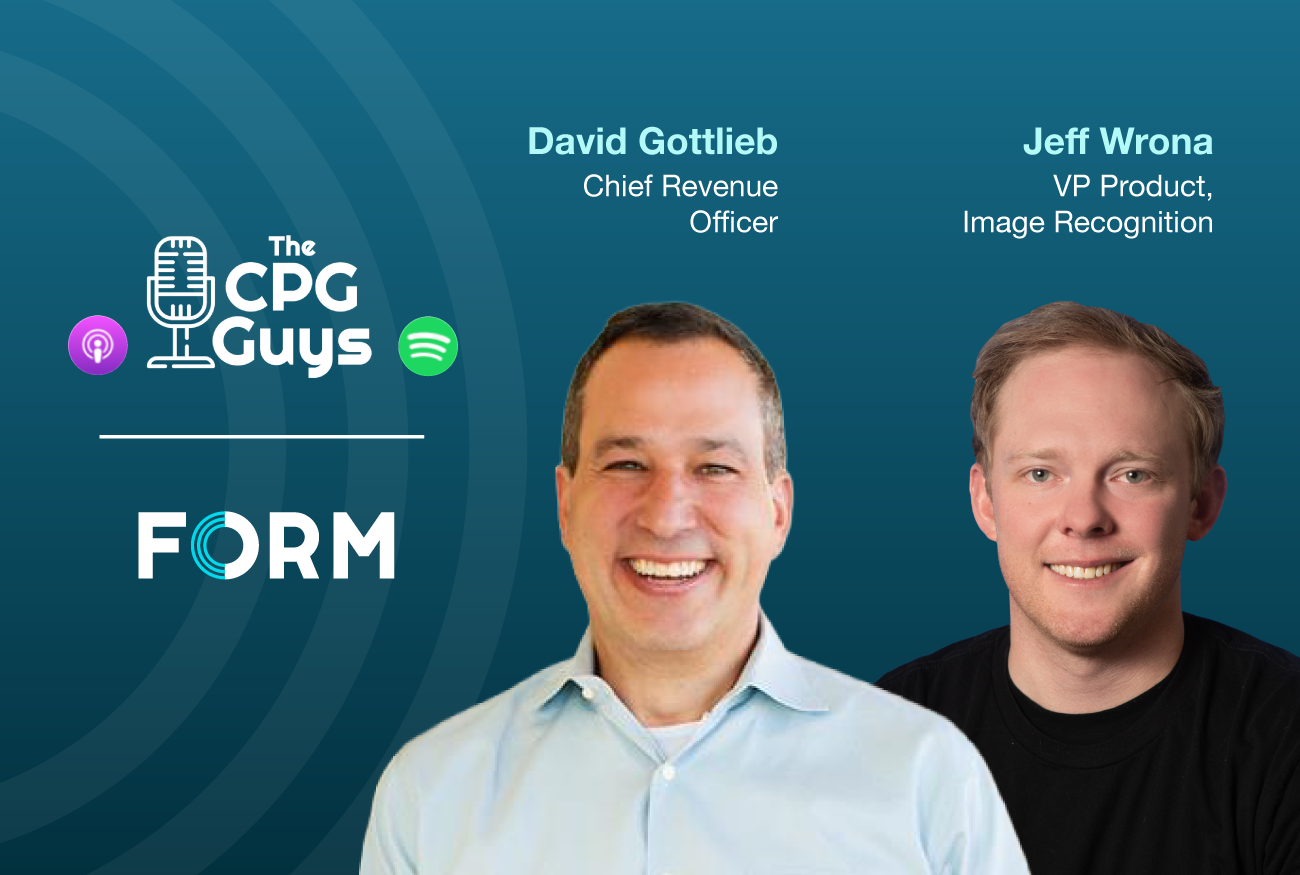
David Gottlieb, Chief Revenue Officer at FORM, and Jeff Wrona, VP of Product for Image Recognition, recently joined Sri Rajagopalan and Peter V.S. Boudreaux on the CPG Guys podcast to discuss the FORM and Trax Retail merger, the real-world promise of agentic AI, and why flawless in-store execution has never mattered more. Below is an edited recap of the conversation.
Key takeaways from the conversation
- The FORM and Trax merger combines best-in-class mobile task management with industry-leading image recognition on a single platform.
- Shared image recognition models proactively identify competitor SKUs, giving brands a real-time competitive edge.
- AI isn’t just answering questions; it is proactively surfacing trends and alerting teams to execution gaps before they appear in syndicated data.
- Dashboards don’t sell products. Combining shelf-level data with mobile workflows allows field teams to fix compliance issues the moment they are identified.
What does the FORM + Trax merger mean for CPG brands?
David Gottlieb describes the two companies as siblings raised by different parents who have finally come home to the same family. Form grew up around task management — organizing complex sets of in-store activities for field teams, driving accountability, and ensuring quality execution. Trax, on the other hand, pioneered image recognition well before AI became a mainstream conversation. The merger brings those two strengths together in a way that is, as Gottlieb puts it, “pretty unique in the industry.”
The practical result for customers is a single platform that combines best-in-class field execution with best-in-class computer vision. Teams can now use image recognition not just to understand what is happening on the shelf, but to directly inform and prioritize what needs to happen next. That data also flows upstream, feeding category management, trade planning, and headquarters selling processes with a level of granularity that wasn’t previously possible.
The merger also brings meaningful global reach.
Trax has long focused on true multinational CPG companies, building out customer success and delivery infrastructure across markets around the world. That network is now available to the broader FORM customer base — a significant expansion of capability for brands that operate across borders.
How does proactively onboarding popular SKUs shift image recognition from reactive reporting to a proactive competitive edge?
Historically, one of the sticking points with image recognition has been competitive data. Getting a clean, up-to-date list of a brand’s own products was manageable. Getting that same quality of data for every competitor in the market was a different challenge entirely.
Jeff Wrona explains that FORM has addressed this through shared image recognition models — models trained and deployed across multiple customers within a given region. Every subscriber benefits not only from visibility into their own brands, but into the competitive landscape as well. And because the models are continuously analyzing real-world shelf data, they surface the most commonly appearing unknown products and proactively work to identify and onboard them. The known product universe closes over time, automatically.
When combined with the robust KPI engine Trax built over the years, the result is visibility into product presence, positioning, pricing, share of shelf, out-of-stocks, and promotional activity — for both owned and competitive SKUs — delivered at a speed and precision that syndicated data simply cannot match.
What does "agentic AI" realistically mean for a CPG organization in the next three to five years?
The honest answer, Gottlieb says, is that it’s not hype — it’s real, and manufacturers need to start thinking carefully about where their points of leverage are.
The challenge CPG companies consistently raise isn’t a shortage of data. It’s knowing what to do with it. Large language models are, in many ways, a natural fit for the kind of structured, purpose-built data that FORM and Trax generate. A privately trained model built on shelf-level execution data could allow a brand manager to ask natural-language questions — which regions are losing share of space, which new competitors are gaining facings, where promotional compliance is falling short — and get answers instantly, without waiting for an analyst to build a report.
The agentic layer goes one step further. Rather than waiting for a question, a curated set of AI agents could proactively surface trends: alerting a team that a new competitor has been gaining distribution in the Southwest, for example, before that brand even shows up in syndicated data. The result, as Gottlieb describes it, is an amplifier for the human team — not a replacement, but a way to significantly extend the value of the people and the technology investment already in place.
Wrona adds that as teams grow more comfortable interacting with AI tools across the business — from BI platforms to supply chain systems — the value will increasingly come from the quality and breadth of the data feeding those agents. Shelf-level execution data, with its granular SKU-by-SKU, store-by-store, day-by-day detail, becomes a critical foundational layer for any broader AI strategy.
If you were building the modern CPG tech stack from scratch, what happens when image recognition data is integrated directly into sales, supply chain, and marketing systems?
Real-time in-store data has become, as Wrona puts it, an essential component of success in retail — and the cost of missing it is concrete. Without image recognition as an input, a brand faces slower response times to execution issues, no real-time visibility into competitive moves, and no leading indicator for supply chain decisions. When a competitor launches an innovation or runs an aggressive price promotion, a brand without shelf-level visibility will see it in syndicated data weeks later. When a successful promotional event drives unexpected velocity and cleans out inventory, an out-of-stock appears without warning.
Image recognition changes the frame for category managers as well. With it, teams can finally answer a question that has long gone unanswered: was the planogram we designed actually executed in store, or did the plan fail at the shelf? That distinction — between a strategy that didn’t work and a strategy that was never actually implemented — is enormously important, and it’s one that granular shelf data makes answerable for the first time.
Macro trends like GLP-1 and declining alcohol consumption among younger generations are reshaping categories. Can shelf-level data surface those shifts faster than syndicated sources?
Gottlieb’s straightforward answer is yes — because the change shows up first at the shelf.
When alcohol consumption patterns shift, retailers respond. Non-alcoholic beer begins claiming more facings. Display space gets reallocated. Promotional activity evolves. All of that is visible in real time through image recognition, at any store a brand chooses to look at, and at a store-level granularity that syndicated data — which aggregates across panels and DMAs — often can’t provide. For brands trying to understand how categories are evolving and how to respond, that early signal is genuinely valuable.
The same logic applies to snacking and other categories being affected by GLP-1 medications. The shelf reflects shopper and retailer behavior before most other data sources do.
With tariffs and price volatility squeezing margins, does flawless in-store execution become the single biggest lever brands still control?
With value-seeking behavior on the rise, brand loyalty is under pressure. Wrona cites data suggesting more than 80% of shoppers have modified their purchasing behavior, with a significant shift toward private label and discount retail. In that environment, price and promotional execution matter more than they have in years — and the cost of execution gaps compounds.
A brand running a two-for-one promotion that drives strong velocity and cleans out shelf inventory has an immediate out-of-stock problem if the supply chain can’t detect and respond to it in real time. Image recognition provides that leading indicator. In grocery specifically, Wrona notes that loss prevention in perishable categories — produce, fresh meat, seafood — is an area where retailers have seen immediate and measurable benefit from shelf scanning. Product sitting in back stock has a shrinking window of viability; knowing it needs to be on the floor right now is a meaningful operational advantage.
You've said publicly that "dashboards don't sell products." How does combining AI-powered image recognition with mobile task management actually close the gap between identifying a problem and fixing it?
Gottlieb draws a historical analogy: the availability of electronic point-of-sale data enabled perpetual inventory and computer-assisted ordering, effectively making the modern supply chain possible. He sees continuous shelf-condition data as a similarly significant inflection point for the industry.
The most immediate application is at the store level. A field rep or DSD operator standing in front of a shelf can scan it with a mobile app and receive, in real time, a prioritized list of what is out of compliance and exactly how to correct it — whether that means pulling backstock, correcting a planogram, or flagging a distribution void. The guesswork of evaluating a complex 40-foot section is replaced with a clear, action-ready workflow.
But not every problem is solvable at the store level, and that’s where the platform’s ability to route data upstream matters. Distribution issues, centrally programmed programs that aren’t being executed, supply signals that need to inform replenishment decisions — all of that requires the same shelf-condition data to flow into trade planning tools, supply chain systems, and enterprise platforms, so that the right people in the right places can act on it. Closing the execution gap, as Gottlieb frames it, means building those pathways across the entire business.
Creator-led and celebrity-founded brands are disrupting the physical shelf at an unprecedented pace. What new challenges do they pose for traditional CPG players?
Creator brands with genuine star power can grow in ways that outpace anything traditional marketing muscle can match, Gottlieb says. The combination of celebrity endorsement, social media reach, and viral content drives velocity that large multinationals have largely responded to through acquisition — Casamigos, Aviator Gin, and similar properties in the spirits space being the most visible examples.
But the same real-time visibility that helps brands track their own execution can also function as an early warning system for competitive disruption. A new challenger brand gaining distribution and facings in independent stores will show up in image recognition data before it registers in syndicated sources. For brands that might otherwise have missed the signal until a competitor had already established meaningful market presence, that lead time has real strategic value. As Gottlieb notes, the dynamics of creator brands are not confined to any single category — the disruption is spreading, and the speed of response is what separates brands that catch the wave from those that chase it.
Over 80% of retail sales still happen in physical stores. How can brands manage their physical presence with the same precision and responsiveness as their digital storefronts?
The e-commerce experience has fundamentally changed what shoppers expect: the ability to search, filter, sort, read reviews, and make a confident purchase decision. Physical retail has historically made that experience much harder. Gottlieb describes a future — built on technology available today — where that changes.
Imagine a shopper standing in front of a beer set, holding up a phone and asking for a locally brewed, gluten-free option. Because the same image recognition that identifies products on a shelf for a field rep can work through an augmented reality lens for a consumer, the phone recognizes every product in the set and overlays a visual filter highlighting exactly what matches. Reviews surface in real time. And for the retailer and brand, that moment of truth creates a live marketing opportunity — a chance to reach a specific shopper with a specific need at precisely the right moment.
For regional and independent retailers, Gottlieb sees a leapfrog opportunity. National chains haven’t deployed this kind of in-store experience at scale yet. Smaller operators, with their ability to move faster, can get there first — and use it to build the kind of loyalty that makes a shopper choose their store over every other option.
Looking out five years, will data maturity and execution intelligence become a meaningful factor in how investors value CPG companies?
Both Gottlieb and Wrona are thoughtful here. Neither claims that image recognition data alone will rewrite valuation models. But Gottlieb makes a clear case that growth potential — what investors are ultimately underwriting — is increasingly a function of a brand’s demonstrated ability to execute at scale and consistently meet shopper expectations. That’s not separable from the quality of in-store execution or the sophistication of the data infrastructure behind it.
Wrona points to the analogy of category captainship: the brands that earn that role with retailers aren’t necessarily the largest ones. They’re the ones that can walk into a planning conversation with real data, make credible recommendations about space allocation, and demonstrate that their proposals drive sell-through for both sides. That kind of data-driven partnership increasingly requires exactly the kind of granular, real-time shelf intelligence that FORM and Trax are built to provide.
To learn more about how FORM’s combined platform is transforming in-store execution and shelf intelligence, visit form.com or connect with us on LinkedIn.