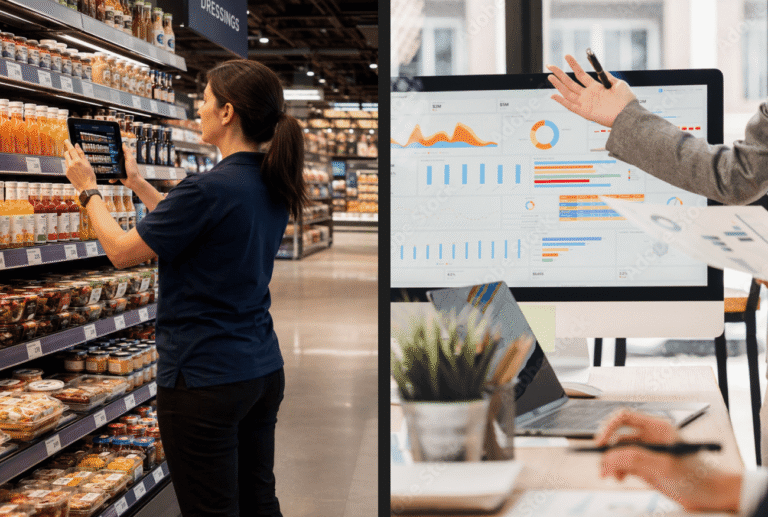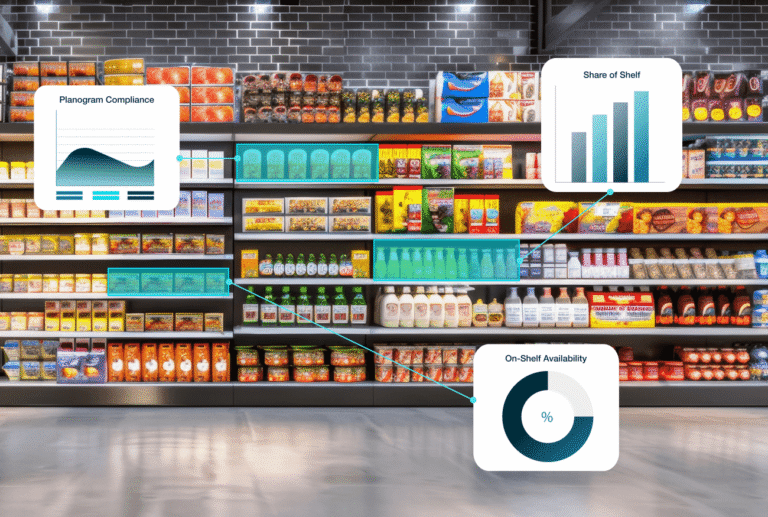


Enterprise grocers have made enormous strides in digitizing center-store execution. Shelf audits are faster, planogram compliance is measurable, and out-of-stock alerts fire in real time. But step past the center aisles and into the fresh perimeter (Produce, Meat, Seafood), and that visibility largely evaporates. These departments drive more foot traffic and higher margin than almost any other area of the store, yet they’re often still managed with paper forms, subjective walkthroughs, and the institutional knowledge of a department manager who happens to be having a good day.
The stakes are significant. The fresh perimeter is where shoppers make basket-defining decisions, and it’s also where shrink, quality failures, and out-of-stocks do the most damage. Traditional technology was never built for this environment, which is precisely why AI-powered retail image recognition has become the most important operational tool grocers can deploy right now.
This article breaks down why legacy tools fail in fresh departments, how modern visual AI solves the unique challenges of the perimeter, and what operational wins are available to grocers willing to close the visibility gap.
Why Standard Retail Technology Fails in Fresh Departments
Conventional retail technology was designed around a single assumption: that every product has a readable label. Barcode scanners, radio-frequency identification (RFID) tags, and most early image recognition systems all function well when items are pre-packaged and consistently branded. In center-store aisles, that assumption holds. In fresh departments, it falls apart almost immediately.
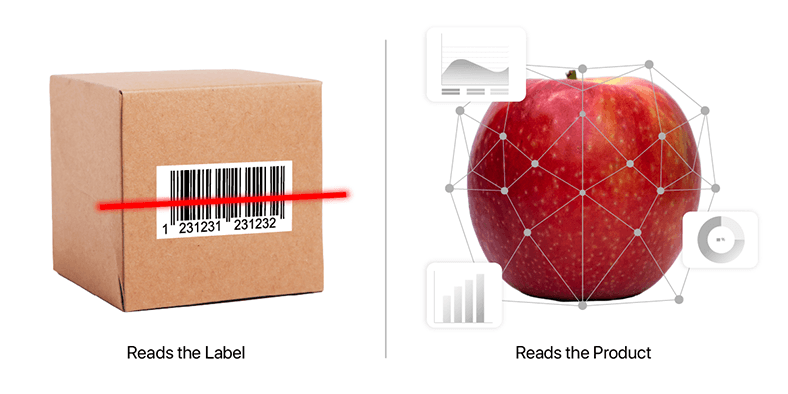
The core challenge is what industry insiders call the “barcode gap.” A loose Honeycrisp apple doesn’t have a Universal Product Code (UPC). A house-butchered ribeye doesn’t carry a manufacturer label a scanner can parse. A bin of fresh produce like seasonal mangoes, loose tomatoes, or bulk peppers carries no readable identifier a field rep can capture in a traditional audit. When your audit tool depends on a barcode, roughly 30–40% of a typical grocery store (the highest-margin, highest-complexity 30–40%) becomes a blind spot.
Visual complexity compounds the problem further. Even when fresh items carry some labeling, identifying them accurately requires distinguishing between look-alike products: a Gala apple versus a Fuji, a Choice-grade strip steak versus Prime, mature yellow bananas versus green ones that are days from being ready. Experienced category managers can make these calls instinctively, but that knowledge doesn’t scale across hundreds of locations, and it certainly can’t be captured on a paper checklist. Standard retail tech has no mechanism to assess ripeness, verify cut-specific merchandising, or confirm that a produce display matches its seasonal planogram when no SKU data is available to anchor the audit.
From SKU-Matching to Visual Intelligence: How AI Masters the Perimeter
The shift that makes fresh perimeter visibility possible is a fundamental change in how AI recognizes products. Earlier generation retail image recognition worked by matching what it saw to a known label or package shape, essentially reading a product’s identity from its packaging. That approach performs reliably when items are uniformly branded and consistently packaged, but it has no framework for interpreting an unpackaged item.
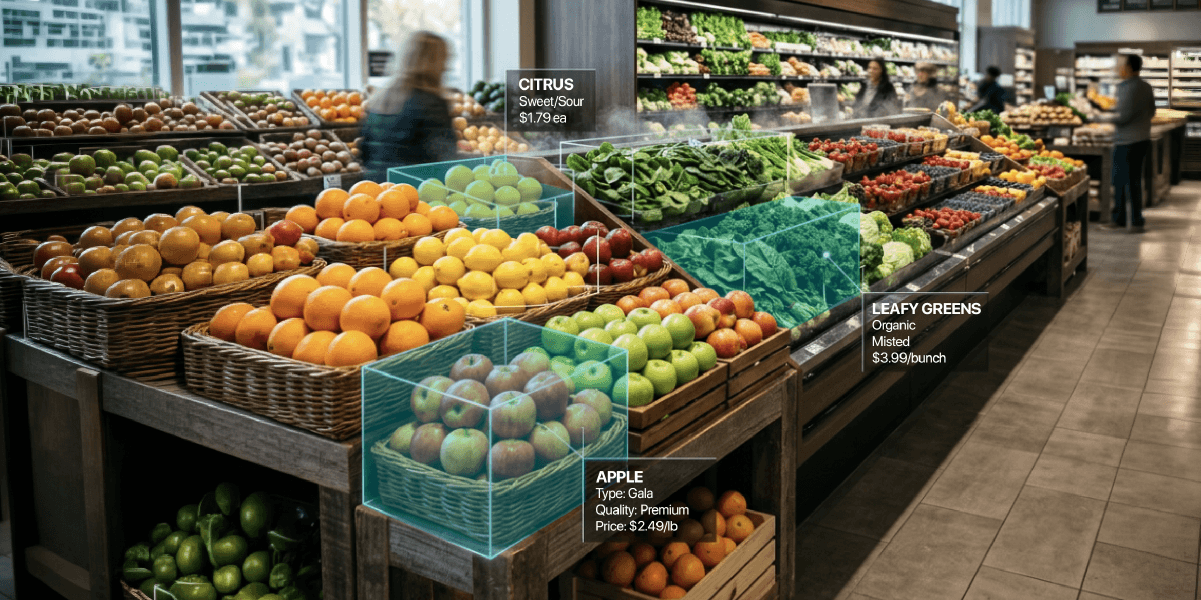
Modern visual AI operates differently. Rather than reading a label, it’s trained to recognize intrinsic visual characteristics: shape, color gradients, surface texture, size ratios, and the positional context of one product relative to another. The practical result is a system that can do things no barcode-dependent tool ever could:
- Distinguish between apple varieties like a Honeycrisp and a Gala by analyzing skin tone, surface sheen, and shape
- Classify a beef cut by visible muscle structure and fat marbling, without any manufacturer label
- Detect whether a fresh produce display is fully stocked, partially faced, or showing a void in real time
Think of it as the trained eye of an experienced produce or meat specialist, operating at the speed and scale of software.
GoSpotCheck by FORM has been built to operate in exactly this environment. (Learn more about GoSpotCheck’s image recognition capabilities.) The platform uses augmented reality (AR) scanning to build a real-time digital twin of perishable displays (produce racks, meat cases, and seafood counters), delivering shelf health and assortment data in seconds. Through FORM’s 2026 partnership with Trax, one of the leading shelf intelligence platforms globally, GoSpotCheck combines its field execution and task management strengths with even deeper computer vision capabilities, giving enterprise grocers a genuinely comprehensive solution for perimeter-ready retail execution. (See what the FORM x Trax partnership makes possible.)
Driving Revenue and Efficiency: Operational Wins in the Fresh Perimeter
The business case for deploying retail image recognition in fresh departments is grounded in three distinct areas of operational impact. Each one addresses a pain point that manual auditing methods typically leave unresolved.
Reducing shrink and food waste
Shrink is the single largest profitability drain in fresh departments, and most of it is preventable if you catch it early. Photo-validated inventory visibility gives Fresh Category Managers the ability to identify stocking imbalances and quality issues across fresh produce and perishable displays before they escalate into spoilage events. When a GoSpotCheck AR scan flags that bananas on a display are overripe and need rotation, that alert goes directly to the store associate responsible, with the specific bin or rack location attached, before the product becomes unsaleable. Research cited in grocery operations literature suggests that cutting shrink by just half a percentage point can lift net income by nearly 17%. With real-time visibility replacing reactive end-of-day walkthroughs, grocers can begin protecting those margins systematically rather than hoping a department manager catches problems in time.
Maximizing high-margin availability in meat and seafood
The meat and seafood cases represent some of the highest revenue-per-square-foot real estate in any grocery store. They’re also the departments where a stocking gap at peak shopping hours causes the most direct revenue loss, because shoppers rarely substitute a center-of-plate protein the way they might swap one brand for another. They simply don’t buy. GoSpotCheck’s out-of-stock and void detection generates real-time alerts the moment a high-velocity SKU (whether that’s a premium cut of salmon or a core pack of ground beef) drops below the threshold for full availability. Associates get directed to the exact location that needs attention, and managers get visibility into how quickly gaps are being resolved across every location.
Ensuring merchandising, pricing, and safety compliance
Fresh department compliance goes beyond assortment. Perishable displays have to meet brand merchandising standards, carry correct localized pricing, and comply with food safety protocols, all of which are difficult to verify consistently at scale without photo evidence. GoSpotCheck’s planogram compliance tracking verifies that fresh sets match approved configurations in real time, with photo documentation that gives operations leaders undeniable proof of execution. Pricing detection links observed shelf tags to the correct items, flagging discrepancies before a customer notices. Safety documentation (freshness dating, display temperature compliance, rotation protocols) gets captured digitally rather than relying on handwritten logs that no one can easily audit later.
Taken together, these wins replace the guesswork of manual walkthroughs with what operations leaders often call “Truth from the Field”: a verified, photo-backed record of what is actually happening at the shelf, available in real time rather than days after the fact. That shift also frees store associates from administrative data entry, allowing them to spend more time on the floor making the decisions that actually drive sales.
Enterprise-Grade Execution: What Grocers Need in a Perimeter-Ready Solution
Not all retail image recognition platforms are built for the real conditions of a live grocery environment. When evaluating solutions for fresh department deployment, operational viability on the actual store floor matters as much as the underlying AI capabilities. A platform that slows reps down or fails in low-connectivity areas will see adoption collapse quickly, and an unused tool produces no shelf visibility no matter how sophisticated its models are.
Works where the store layout demands it
Fresh perimeter environments are notorious for inconsistent Wi-Fi coverage. Walk-in coolers used to stage fresh produce and raw meat, backroom prep areas, and low-signal zones are common features of grocery store layouts, and they’re exactly where visibility gaps tend to form. GoSpotCheck captures images and completes audits offline, syncing automatically once a connection is restored. No data is lost regardless of where in the store a rep is working.
Turns photos into action, not just reports
Capturing an image of a meat case is only valuable if that image is automatically analyzed, structured, and routed into the right workflow within minutes. GoSpotCheck connects image recognition directly to task management and business intelligence dashboards, so a display compliance gap detected in produce at 8 a.m. generates a prioritized task for an associate by 8:05, not at end of day when the window for corrective action has passed. This tight integration between visual data capture and operational workflow is what separates a genuine enterprise execution platform from a standalone AI tool that produces reports but doesn’t drive action.
GoSpotCheck by FORM bridges the full store, from center-store aisles where retail technology has long been effective to the fresh perimeter departments that have historically resisted digitization.
Achieving The "Full-Store Truth" with AI
Enterprise grocers who have invested in digital execution tools for center-store have made meaningful progress, but visibility that stops at the edge of the produce or meat department leaves the most complex and profitable sections of the store operating on instinct and incomplete information. Real operational intelligence requires consistent, verified data from every department, every day.
Deploying advanced retail image recognition in fresh departments transforms what have traditionally been high-shrink, hard-to-monitor zones into data-driven operations where problems are caught early, compliance is documented, and high-margin items stay consistently available. The result is a measurable competitive advantage. Grocers who can demonstrate planogram compliance, track shrink reduction, and optimize labor deployment across their fresh perimeter have the kind of visibility that supports smarter supplier negotiations, better category planning, and more confident strategic decisions at every level of the organization.
Ready to see what perimeter-ready retail execution looks like in practice? Explore GoSpotCheck by FORM’s shelf intelligence capabilities and book a demo to see fresh department image recognition in action.